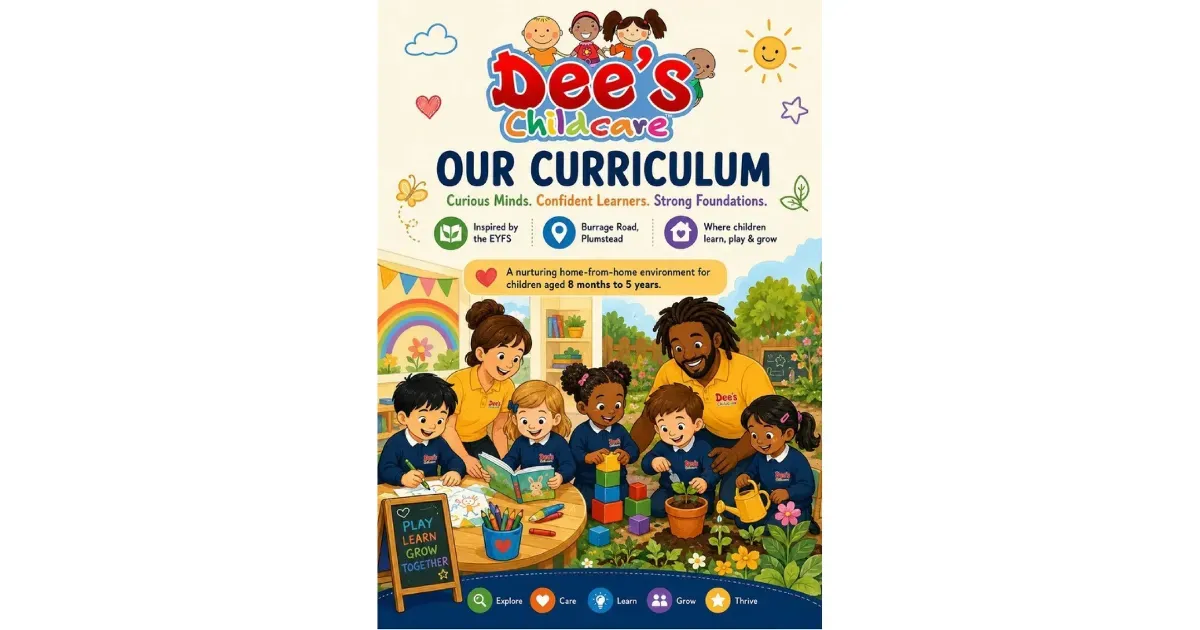
Our Curriculum

We have our very own curriculum that incorporates the EYFS (The Early Years Foundation Stage). The EYFS sets the standards that all early years providers must meet to ensure that children learn and develop well and are kept healthy and safe. It promotes teaching and learning to ensure children’s ‘school readiness’ and gives children the broad range of knowledge and skills that provide the right foundation for good future progress through school and life.


Core Purpose

To provide a safe, nurturing, stimulating environment where children aged 8 months–5 years learn through play, exploration, routine, and meaningful relationships. The curriculum supports children’s holistic development and prepares them confidently for school.


1. Curriculum Intent / Principles

Vision

At Dee’s Childcare, our curriculum is designed to give every child the best possible start in life. We aim to nurture confident, curious, independent learners who feel safe, valued, and ready for school.


Our Core Intentions

● Support holistic development across all EYFS areas.
● Build strong communication and language foundations.
● Promote emotional security, resilience, and independence.
● Provide a rich, play-based learning environment.
● Reflect the diversity of Burrage Road and the wider Woolwich community.
● Work in close partnership with parents to support consistent learning.


Our Core Principles

● Child-centred: led by children’s interests and developmental needs.
● Inclusive: accessible to all children, including SEND and EAL learners.
● Sequential: building skills progressively from birth to age 5.
● Real-world learning: using the home, garden, and local community.
● Language-rich: talk, stories, songs, and conversation embedded daily.


At Dee’s Childcare, we do all we can to give children the best start in life. Through the development of our own curriculum, we support the holistic development of the children in our care. Our curriculum boosts confidence, critical thinking and the child's desire to learn. Therefore, in preparation for school, our children demonstrate a level of independence as they evolve into confident little learners.

Our curriculum further supports nine additional aims for child development, which we feel very passionate about.

● Child-centred — activities that follow children’s interests and developmental needs.
● Play-based learning — hands-on, exploratory, and imaginative play.
● Inclusive & culturally responsive — embracing the diversity of Burrage Road and the surrounding Woolwich community.
● Strong home–setting partnership — regular communication with parents and carers.
● Consistent routines — which support emotional security.
● Fostering environmental awareness, engaging with nature and appreciating the natural environment - through our Forest Childcare experiences.
● Having a healthy lifestyle - by providing varied nutritious plant-based meals.
● Developing a genuine love for books, storytelling and language - nurtured by utilising regular visits to local libraries, talk-boost and Makaton.
● Becoming kind, empathetic and resilient - by practitioners demonstrating behaviours and appropriate language which reflect this.

In addition, we offer varied extra-curricular activities, as we work in close partnership with other local Small and Medium-sized Enterprises (SME’s) to enhance our curriculum.

To link to Term Time Extracurriculars.


2. Curriculum Implementation

Teaching & Learning Approach

We deliver learning through:

● Play-based exploration and experiences
● Adult-guided play and learning activities
● Daily routines (snack time, tidy-up time, transitions)
● Outdoor play and learning
● Real-life experiences (cooking, gardening, local walks)
● Repetition and modelling to embed learning

We use a balanced mix of:

● Child-initiated play
● Adult-led small-group activities
● One-to-one interactions


3. Teaching & Learning Approach

Our tailor-made curriculum encompasses all seven areas of learning from the EYFS Development Matters Guidance.


EYFS Areas of Learning (with Dee’s Childcare approach)


1. Communication & Language

We prioritise:
● Vocabulary development
● Listening and attention
● Back-and-forth conversations

How we teach it:
● Daily story time
● Singing and rhyme sessions
● “Talk tables” with themed objects
● Modelling new vocabulary
● Small-group discussions


2. Personal, Social & Emotional Development

We support children to:
● Build confidence
● Manage emotions
● Form positive relationships
● Develop independence

How we teach it:
● Feelings board
● Turn-taking games
● Conflict-resolution modelling
● Helping with routines
● Celebrating cultural diversity


3. Physical Development

We develop:
● Gross motor skills
● Fine motor control
● Self-care and health awareness

How we teach it:
● Outdoor play (bikes, balls, climbing)
● Mark-making
● Playdough, threading, tweezers
● Dance and movement
● Healthy eating discussions


4. Literacy

We build early reading and writing foundations.

How we teach it:
● Daily stories and phonics-rich books
● Name recognition
● Mark-making journals
● Story baskets
● Library visits


5. Mathematics

We develop:
● Number sense
● Shape, space, and measure
● Patterns and problem-solving

How we teach it:
● Counting songs
● Sorting and matching
● Shape hunts
● Cooking (measuring, comparing)
● Block play


6. Understanding the World

We help children explore:
● Nature
● Community
● Cultures
● Technology

How we teach it:
● Nature walks on Burrage Road
● Seasonal exploration
● Festivals and cultural days
● Simple technology (torches, tablets)
● Cooking from different cultures


7. Expressive Arts & Design

We encourage:
● Creativity
● Imagination
● Expression

How we teach it:
● Painting, collage, junk modelling
● Role-play
● Musical instruments
● Small-world play
● Weekly themed crafts


Some of our Adult- Led Monthly Themes incorporated with Child-led interests

● All About Me
● People Who Help Us
● Animals & Nature
● Transport
● Colours & Shapes
● Food & Cooking
● Weather & Seasons
● Community & Culture


📝 5. Assessment & Observation

Dee’s Childcare uses:
● Short daily observations
● Termly developmental summaries
● Parent communication via WhatsApp or a simple learning journal
● EYFS tracking to identify next steps


🤝 6. Parent Partnership

● Monthly newsletters
● Daily handover notes
● Parent workshops (toilet training, speech development)
● Celebrations: birthdays, cultural days, end-of-term events


🌟 7. Environment Setup

● Cosy reading corner
● Sensory area (lights, textures, water play)
● Construction zone (blocks, magnets)
● Creative table (art materials)
● Outdoor space with bikes, sand, water, and nature exploration


🔍 8. Safeguarding & Welfare

● Clear safeguarding policy
● First-aid trained staff
● Allergy-aware snack policy
● Regular risk assessments
● Calm behaviour-management approach


4. Sequencing & Progression

Our curriculum is structured around progressive skill development:


8 months–2 years

● Secure attachments
● Sensory exploration
● Early communication
● Physical development through movement
● Simple cause-and-effect play


2–3 years

● Expanding vocabulary
● Early independence
● Simple counting and shape recognition
● Pretend play
● Social interaction and turn-taking


3–5 years

● Early phonics awareness
● More complex problem-solving
● Early writing and number formation
● School-readiness skills
● Understanding rules and routines


We adapt learning for each child using observations, next steps, and individual planning.


4. Assessment

Our Assessment Approach

● No excessive paperwork
● Ongoing observations during play
● Termly developmental summaries
● Two-year progress check
● Parent input included in all assessments

Assessment is used to:
● Identify next steps
● Support early intervention
● Inform planning
● Share progress with parents


5. Inclusion & SEND

We follow the SEND Code of Practice and ensure:
● Early identification of needs
● Adapted activities
● Visual supports
● Sensory-friendly spaces
● Partnership with parents and external professionals

Every child is included in all aspects of the curriculum.


6. Learning Environment

Indoor Environment

● Cosy reading corner
● Construction area
● Creative table
● Sensory play
● Role-play corner
● Quiet space for regulation


Outdoor Environment

● Bikes, balls, climbing
● Sand and water play
● Nature exploration
● Mark-making outdoors
● Seasonal gardening


Emotional Environment

● Quiet Library
● Sensory Den
● Feelings Chart


Local Community

We use:
● Burrage Road walks
● Woolwich Common
● Local shops
● Woolwich Centre Library
● Parks and green spaces


7. Parent Partnership

We work closely with families through:
● Daily handovers
● Learning journals
● WhatsApp updates
● Termly meetings
● Parent workshops
● Cultural celebration days

Parents are partners in their child’s learning journey.


8. Safeguarding & Welfare

We follow all statutory EYFS safeguarding requirements:
● Up-to-date safeguarding training
● First-aid certification
● Risk assessments
● Allergy-aware food policy
● Safe sleep practices
● Behaviour management policy
● Clear procedures for concerns

Children’s safety and wellbeing are always the highest priority.


9. Impact

We measure the success of our curriculum through:
● Children’s progress across EYFS areas
● Their confidence, independence, and curiosity
● Strong communication skills
● Positive relationships
● Readiness for school
● Parent feedback

Our goal is for every child to leave Dee’s Childcare feeling secure, capable, and excited for the next stage of learning.


DEE’S CHILDCARE PEDAGOGY

Our Pedagogical Identity

There are many different pedagogies and beliefs about teaching and learning in Early Years. At Dee’s Childcare, we have developed our own unique approach to learning. We believe that social interaction plays a fundamental role in ensuring a child develops holistically. Our team collaborates with the children to facilitate and scaffold their learning.

Dee’s Childcare follows a warm, relational, play-centred pedagogy rooted in the belief that children learn best when they feel safe, valued, and deeply connected to the adults around them. Our approach blends EYFS principles, attachment-led practice, and real-life learning experiences that reflect the community around Burrage Road.

We focus on nurture, curiosity, communication, and independence as the foundations for lifelong learning.

We feel passionately that children learn best by ‘doing’ and having real-life experiences, and that happy, self-motivated children will become confident and successful in the future. This is not a nursery for worksheets! Dee’s Childcare’s approach is always child-centred and a model of discovery, where children learn about the awe and wonder of the world!


1. Our Pedagogical Values

1.1 Relationships First

Children thrive when they feel emotionally secure.

Our pedagogy is built on:
● Strong attachments
● Consistent routines
● Warm, responsive interactions
● Respectful communication


1.2 Learning Through Play

Play is the primary vehicle for learning. At Dee’s Childcare, we use:
● Open-ended resources
● Real-world materials
● Child-initiated exploration
● Adult-guided provocations


1.3 Language-Rich Practice

Communication and language underpin every part of our pedagogy.

We embed:
● Constant back-and-forth conversation
● Vocabulary modelling
● Storytelling
● Singing and rhyme
● Opportunities for children to express themselves

We believe that talk is teaching.


1.4 Inclusive, Culturally Responsive Learning

Our pedagogy reflects the diversity of Burrage Road and the wider Woolwich community.

We ensure:
● Representation in books, toys, and displays
● Celebration of cultural events
● Respect for home languages
● Adaptations for SEND and EAL learners


1.5 Real-Life, Hands-On Learning

Children learn best when experiences are meaningful.

We use:
● Cooking
● Gardening
● Local walks
● Nature exploration
● Community visits


1.6 Scaffolding and Modelling

Adults play an active role in extending learning.

We use:
● Sensitive questioning
● Demonstration and modelling
● Repetition and reinforcement
● Breaking tasks into manageable steps


2. How We Teach (Pedagogical Methods)

2.1 Child-Led Exploration

Children choose activities based on their interests.


2.2 Adult-Led Moments

Short, purposeful activities introduce new skills:
● Story sessions
● Small-group games
● Early maths and phonics activities
● Creative projects


2.3 Environment as the “Third Teacher”

We design the environment to promote independence and curiosity:
● Low-level shelving
● Open-ended resources
● Cosy reading spaces
● Sensory materials
● Outdoor learning zones


2.4 Repetition and Routine

Children learn through predictable patterns.


2.5 Observation-Led Planning

We watch, listen, and respond.

Planning is flexible and based on:
● Children’s interests
● Developmental needs
● Cultural experiences
● Seasonal opportunities


3. What Makes Dee’s Childcare Pedagogy Unique

● A Home-from-Home Learning Culture
● Strong Community Connection
● Focus on Emotional Literacy
● High-Quality Interactions
● Blended Approaches


4. The Impact of Our Pedagogy

We know our pedagogy is working when children show:
● Confidence and curiosity
● Strong communication skills
● Independence in daily routines
● Positive relationships
● Emotional awareness
● Progress across EYFS areas
● Readiness for school


Dee’s Childcare – Cultural Capital Statement

What Cultural Capital Means at Dee’s Childcare

At Dee’s Childcare, cultural capital means giving every child — regardless of their starting point — the knowledge, experiences, confidence, and opportunities they need to thrive in life.


1. Our Cultural Capital Principles

1.1 Every Child’s Background Matters

We value each child’s:
● Culture
● Language
● Family traditions
● Life experiences
● Strengths and interests


1.2 Broadening Horizons

We intentionally expose children to experiences such as:
● Nature walks
● Cooking activities
● Music and instruments
● Books from diverse cultures
● Visits to local community spaces
● Celebrations of festivals and traditions


1.3 Building Confidence and Communication

We prioritise:
● Vocabulary development
● Storytelling
● Singing and rhyme
● Conversations during routines
● Opportunities to express ideas


2. How We Build Cultural Capital

2.1 Experiences Within the Setting

● Cooking and tasting foods from different cultures
● Sensory play inspired by global traditions
● Role-play based on real-life jobs and community helpers
● Art inspired by different countries
● Music from around the world
● Storybooks featuring diverse characters and families


2.2 Experiences in the Local Community

● Walks to local parks and green spaces
● Visits to Woolwich Centre and surrounding Libraries
● Trips to local shops and markets
● Observing buses, trains, and community workers
● Exploring nature in the local environment


2.3 Celebrating Diversity

● Nubian History Month
● Diwali
● Christmas
● Eid
● Easter
● Birthdays
● Family traditions shared by parents


2.4 Life Skills and Independence

● Putting on coats and shoes
● Helping prepare snacks
● Tidying up
● Growing and caring for plants
● Understanding routines
● Using manners and social skills


3. Cultural Capital for Children With SEND or EAL

● Visual supports
● Makaton signs
● Repetition and modelling
● Sensory-friendly experiences
● Respect for home languages
● Close partnership with parents


4. The Impact of Our Cultural Capital Approach

● Show curiosity about the world
● Use new vocabulary confidently
● Demonstrate respect for others
● Engage in new experiences with enthusiasm
● Develop independence and resilience
● Are ready for school with a broad base of knowledge


Dee’s Childcare – Characteristics of Effective Learning

1. Playing and Exploring (Engagement)

How this looks at Dee’s Childcare

● Explore open-ended resources
● Engage in sensory play
● Try new experiences with confidence
● Use their imagination in role-play
● Show curiosity during local walks and nature exploration
● Return to favourite activities to deepen understanding


2. Active Learning (Motivation)

How this looks at Dee’s Childcare

● Persist with puzzles, construction, and problem-solving
● Show pride when they master new skills
● Join in songs, stories, and routines with enthusiasm
● Return to activities to practise and improve
● Manage small challenges independently


3. Creating and Thinking Critically (Thinking)

How this looks at Dee’s Childcare

● Ask questions and make predictions
● Try different ways to solve a problem
● Use imagination in small-world and role-play
● Make links between experiences
● Plan their play and adapt ideas
● Talk about what they are doing and why


How We Embed CoEL Across the Curriculum

Environment

● Open-ended resources
● Low-level shelving for independence
● Sensory materials
● Outdoor learning every day
● Real-life tools and experiences

Interactions

● Warm, responsive, language-rich
● Scaffolding and modelling
● Encouraging curiosity and resilience
● Supporting children to think aloud

Planning

● Observation-led
● Flexible and responsive
● Based on children’s interests
● Focused on developing learning behaviours

Assessment

● Identify next steps
● Support school readiness
● Build children’s confidence and independence
● Share progress with parents


Impact of CoEL at Dee’s Childcare

● Show curiosity and enthusiasm
● Persist with challenges
● Communicate their ideas
● Solve problems independently
● Show pride in their achievements
● Are confident, resilient, and ready for school